What Matters Now: How to Win in a World of Relentless Change, Ferocious Competition, and Unstoppable Innovation

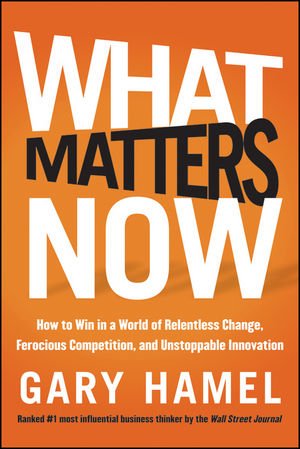
What Matters Now: How to Win in a World of Relentless Change, Ferocious Competition, and Unstoppable Innovation is a promotional item. To increase sales of the product. It can make you love it. What Matters Now: How to Win in a World of Relentless Change, Ferocious Competition, and Unstoppable Innovation is a great product. Quality of work. Corresponds to a very And that it is affordable. I bought it from the Internet to use What Matters Now: How to Win in a World of Relentless Change, Ferocious Competition, and Unstoppable Innovation . And it makes me very impressed. I introduced people I know. Its good to see. Effective The collar is the most in demand. What Matters Now: How to Win in a World of Relentless Change, Ferocious Competition, and Unstoppable Innovation is important to the price. If you want to see detail of What Matters Now: How to Win in a World of Relentless Change, Ferocious Competition, and Unstoppable Innovation . Please click on the Get Discount Price Here.

What Matters Now: How to Win in a World of Relentless Change, Ferocious Competition, and Unstoppable Innovation Overview
This is not a book about one thing. It's not a 250-page dissertation on leadership, teams or motivation. Instead, it's an agenda for building organizations that can flourish in a world of diminished hopes, relentless change and ferocious competition.
This is not a book about doing better. It's not a manual for people who want to tinker at the margins. Instead, it's an impassioned plea to reinvent management as we know it—to rethink the fundamental assumptions we have about capitalism, organizational life, and the meaning of work.
Leaders today confront a world where the unprecedented is the norm. Wherever one looks, one sees the exceptional and the extraordinary:
- Business newspapers decrying the state of capitalism.
- Once-innovative companies struggling to save off senescence.
- Next gen employees shunning blue chips for social start-ups.
- Corporate miscreants getting pilloried in the blogosphere.
- Entry barriers tumbling in what were once oligopolistic strongholds.
- Hundred year-old business models being rendered irrelevant overnight.
- Newbie organizations crowdsourcing their most creative work.
- National governments lurching towards bankruptcy.
- Investors angrily confronting greedy CEOs and complacent boards.
- Newly omnipotent customers eagerly wielding their power.
- Social media dramatically transforming the way human beings connect, learn and collaborate.
Obviously, there are lots of things that matter now. But in a world of fractured certainties and battered trust, some things matter more than others. While the challenges facing organizations are limitless; leadership bandwidth isn't. That's why you have to be clear about what really matters now. What are the fundamental, make-or-break issues that will determine whether your organization thrives or dives in the years ahead? Hamel identifies five issues are that are paramount: values, innovation, adaptability, passion and ideology. In doing so he presents an essential agenda for leaders everywhere who are eager to...
- move from defense to offense
- reverse the tide of commoditization
- defeat bureaucracy
- astonish their customers
- foster extraordinary contribution
- capture the moral high ground
- outrun change
- build a company that's truly fit for the future
Concise and to the point, the book will inspire you to rethink your business, your company and how you lead.
What Matters Now: How to Win in a World of Relentless Change, Ferocious Competition, and Unstoppable Innovation Specifications
 |
Gary Hamel, one of the world's pre-eminent business thinkers, demonstrates why last century's management theories-- developed more than a hundred years ago during the Industrial Revolution--are entirely wrong for managing today's successful organizations. He shows how yesterday's top-down bureaucratic management models designed to keep employees under control no longer work and how one-way, top-down communications are over.
We've seen how social networks like Twitter and Facebook enable wired citizens to rally crowds, gain global attention, and topple established political systems. We've seen the world change with the Arab Spring. If we don't find a better way to create more transparent, authentic and meaningful relationships with customers and employees, a Corporate Spring and a CEO Spring will be next.
Now, organizations of all sizes can access Gary's innovative ideas to bring business management into the future. Through case studies of forward-thinking companies like W.L. Gore, the company that makes Gore-Tex fabrics, Hamel illustrates the power of principles that center around autonomy and freedom, instead of command-and-control. Hamel illuminates how bold new models that encourage meritocracy--and identify the individual contributors who are actually driving innovations within an organization--will be the norm for successful companies moving forward.
This is a must-read for anyone who wants to succeed in today's world. Many fear change--after all, change is hard--but the world always spins forward and we must embrace change or the world will move on without us. Most of all, we have an incredible opportunity--as well as a responsibility-to redefine management for the next generation and transform our businesses into social enterprises that will be more competitive, more innovative and more successful than ever before possible.
Q&A with Author Gary Hamel
 |
This book is different than previous books you have done. Why this book – why now?
There are a variety of unprecedented changes in the business environment, change continues to accelerate, trust is shaken, and competition is fierce: there is a raft of new competitors.
Organizations are not up to challenges ahead. There are many. The right thing to do was to NOT write a book about one thing – but instead offer 5 levers – and one person's point of view of how to work those levers.
What did you find surprising in writing this book?
Maybe not surprising – but a little shocking – was that despite magnitude of challenges that organizations face, including a dismal economy, most organizations are still fiddling at the margins.
A typical business book looks at companies doing something right at the moment…or companies that screw up. In times of environmental stress and change you have to challenge not only practices but principles. You must challenge fundamental assumptions about how organizations work. Frankly, I don't know of any organizations that are up to the challenges that lie ahead. This book is for people who want to get out in front; it is an agenda for people who want to lead.
Who has most influenced your thinking in the past ten to fifteen years?
Kevin Kelly and his book Out of Control (it came out in 1995.) He helped us understand how social life forms on the web and how that will, and has, affected us all.
Chris Rufer, President of Morningstar, is in the book. His company has demonstrated that you can run complex organizations without any hierarchical structure. I had believed it could be true …but now know it is true.
Out of every critical issue out there now for leaders/managers/workers to focus on what is the one most people should start with?
Values. Every CEO will tell you that they want to an organization that builds superior results. But is values that will get you there. Values need to be transcendental rather than venal. Look at Apple: beauty, ease of use… versus the investment banks and their short term monetary gain for a few. People are rightfully calling capitalism to account. I understand the anger people have. I laugh when a CEO says he wants a "values driven organization" because the organization already is! The question is what values are in the driver's seat already.
What do you hope readers ultimately "get" out of this book?
The responsibility of any business author is to be profound and practical. I want to read things that challenge my convention…my mental models. I also like to spend time talking with CEOs and managers. Ultimately you have to build a bridge between new ideas and the everyday realities. That is my goal.
1. This page is a participant in the Amazon Services LLC Associates Program, an affiliate advertising program designed to provide a means for sites to earn advertising fees by advertising and linking to amazon.com
2. Amazon, the Amazon logo, Endless, and the Endless logo are trademarks of Amazon.com, Inc. or its affiliates.
3. CERTAIN CONTENT THAT APPEARS ON THIS SITE COMES FROM AMAZON SERVICES LLC. THIS CONTENT IS PROVIDED AS IS AND IS SUBJECT TO CHANGE OR REMOVAL AT ANY TIME.
